00About Leava GmbH
We build software the way we would want to inherit it.
Leava GmbH is an IT company focused on custom software development, web platforms, backend systems, cloud infrastructure and integrations. Our work centres on systems that organisations depend on day to day — where reliability and maintainability matter more than novelty.

01Our focus
Business-critical systems
Applications that run operations: order handling, scheduling, reporting, customer data and internal workflows.
Connected environments
Software that has to cooperate with existing ERPs, CRMs, payment providers, identity systems and third-party APIs.
Long-lived codebases
Projects expected to be extended over years, where structure and documentation determine future cost.
02Principles
Four rules that shape the work.
- P1
Clarity over cleverness
Code is written to be read. A straightforward solution that a new developer understands in an afternoon is preferred over an elegant one that only its author can change.
- P2
Small, reversible steps
Changes are delivered in increments that can be reviewed, tested and, if needed, rolled back. This keeps risk proportional to each step.
- P3
Honest estimates
Estimates come with their assumptions and uncertainties stated. When new information changes the picture, the estimate is updated openly.
- P4
Ownership after launch
A release is a milestone, not the end. Software is planned with its operation, monitoring and future changes in mind.
03Engineering mindset
Understand the problem before choosing the tool.
Technology choices follow from requirements, the existing environment and the skills of the people who will maintain the result. Proven, well-supported tools are the default; new ones are introduced when they solve a concrete problem better.
Architecture is kept as simple as the requirements allow. Complexity is added deliberately, documented, and only where it pays for itself.

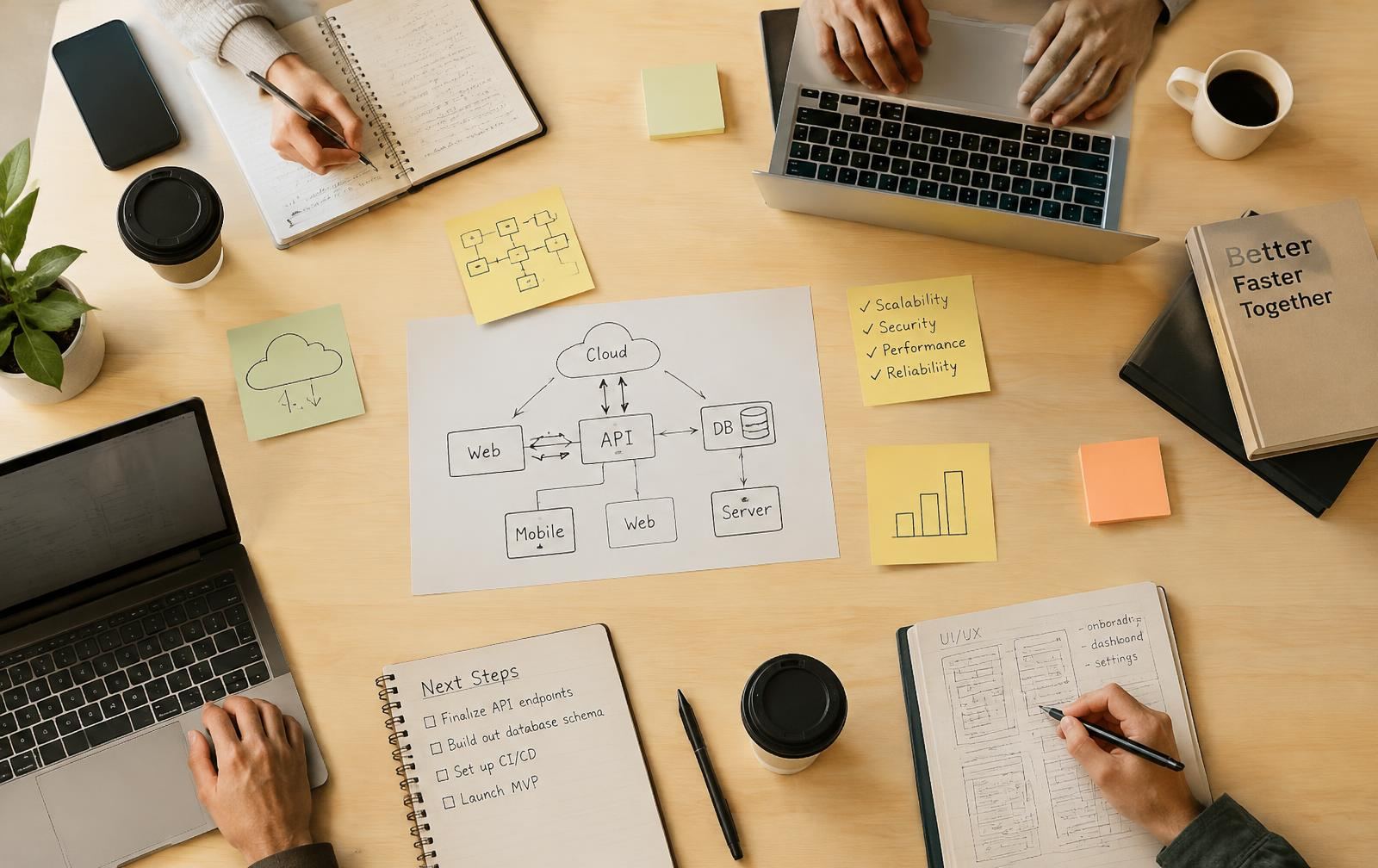
04Collaboration
Working as one team with clients.
- Requirements, decisions and open questions are kept in writing and shared.
- Progress is shown as working software, not only status reports.
- Trade-offs are explained in business terms so they can be decided together.
- Concerns are raised early, when they are still cheap to address.
05Quality standards
What “done” means.
- —Code reviewed by a second developer
- —Automated tests covering the changed behaviour
- —Builds and deployments reproducible from version control
- —Accessibility and performance checked for user-facing changes
- —Documentation updated alongside the code
06Long-term maintainability
Software outlives its first release.
Most of a system’s cost arrives after launch: new features, updated dependencies, changing regulations and new team members. Clear module boundaries, consistent conventions, meaningful tests and written architecture notes keep that cost predictable.
Every handover includes the knowledge needed to operate and extend the software — whether it continues with Leava GmbH or with an in-house team.